credits : Herlandson Duarte, João Fiadeiro
2021 O que fazer daqui para trás_versão expandida w/PACAP5
Artistic direction : João Fiadeiro
Performers : Aline Belfort (BR), Andrei Bessa (BR), Bárbara Cordeiro (PT), Bartosz Ostrowski (PL), Bruno Levorin (BR), Carolina Canteli (BR), Francisco Thiago (BR), Giovanna Monteiro (BR), Herlandson Duarte (CV/PT), Jean Lesca (FR), Katarina Lanier (US), Katinka Wissing (DK), Leonardo Shamah (BR), Leonor Lopes (PT), Leonor Mendes (PT), Lucas Damiani (UY), Nazario Díaz (ES), Nicole Gomes (BR), Nirvan Navrin (PT), Piero Ramella (IT), Roberto Dagô (BR), Rosa Sijben (NL), Ves Liberta (PT), Vicente Antunes Ramos (BR), Chloé Saffores (FR)
Production : Forum Dança
Residency and performance : Forum Dança, Espaço da Penha, Lisboa
This performance is a bi-product of the work O que fazer daqui para trás (What to do from here on backwards), a piece that is very simple: the performers run around a theater until they are in an absolute state of exhaustion and, in that exhausted condition, return to a bare stage – only holding at the center a microphone in a stand – to share with the audience an experience they had outside (something they saw, felt, imagined). In the original work the sharing takes place orally, meaning each performer talks about their experiences (navigating in-between factual, fictionalized and poetically content) while struggling with a wheezing breath that prevents them from coherently articulating words and thoughts. For this to work the body needs to be on the edge of collapse but it can’t actually collapse. The body needs to be exhausted but not tired. As Deleuze puts it: “the tired have only exhausted realization, while the exhausted exhaust all that which is possible” (The Exhausted, Gilles Deleuze, University of Wisconsin Press). The piece needs exhausted performers because it needs them to exhaust “that which is not realized through the possible”.
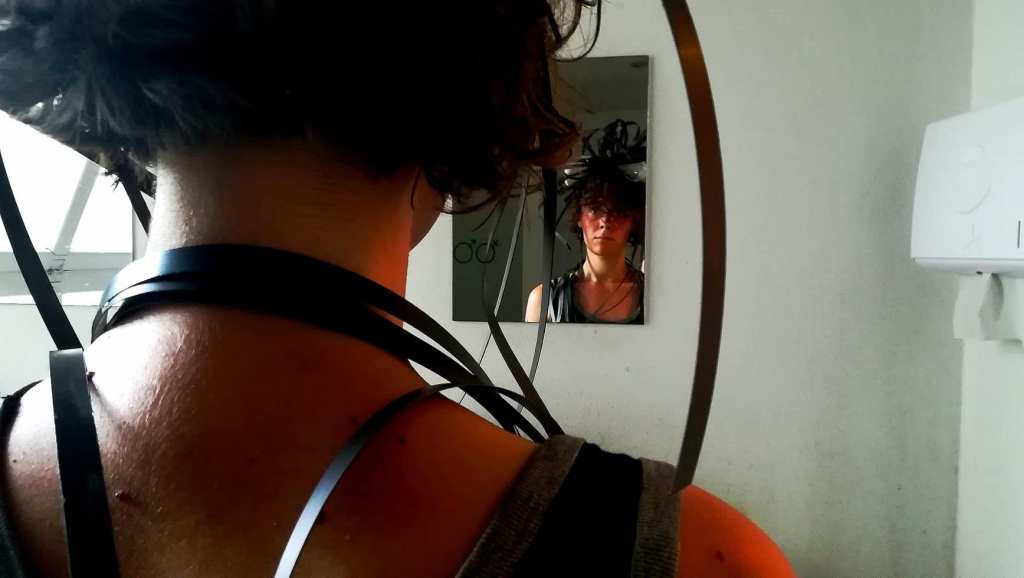
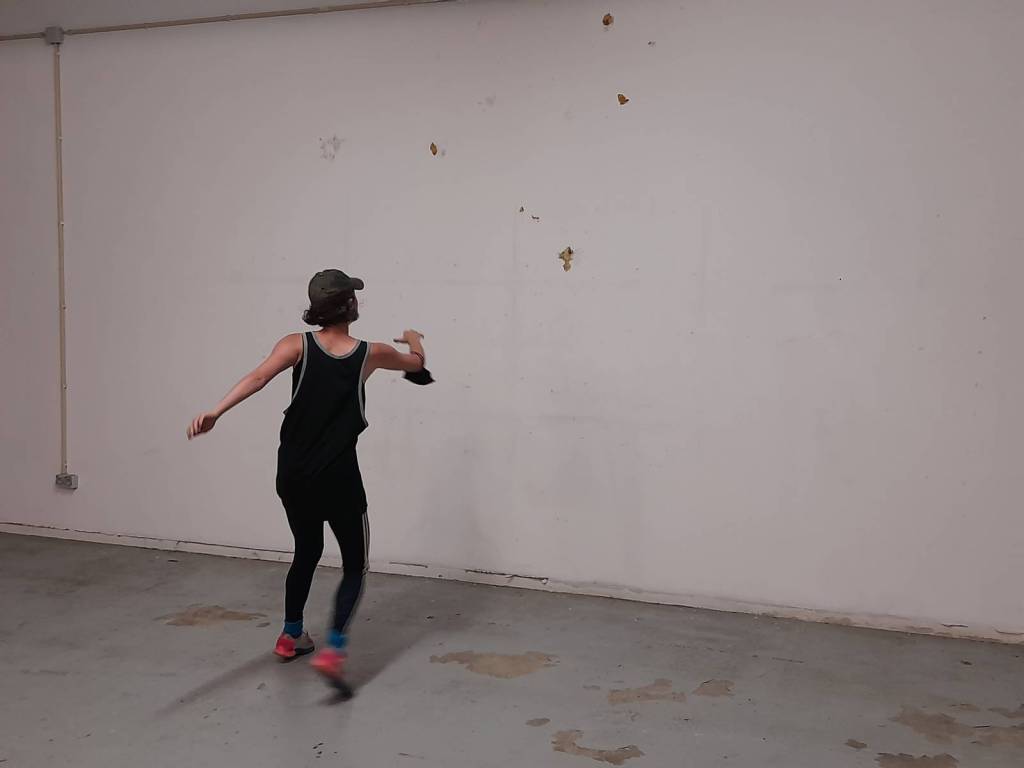
This expanded version shares the basic scenic concept from the stage version with two main differences: the first is that the performers, instead of generating oral discourse as a form of translation of their experiences in the streets, they produce physical discourses in the form of actions and situations that translate a fragment of the experience they had outside the performance space. Secondly, the audience will not stay still and frontal like they would be in a theater but are invited to circulate in an open space between the images and situations generated by the performers.
As the performance progresses the space becomes full of spoils, traces and tracks left by the performers, producing a kind of an installation of “absent presences”, an outcome that is yet another difference from the original work (which visually ends exactly as it began).
→ Website
 chloé saffores